Everything You Should Know About Pyrrhura Species – Species Guides and Our Own Experience
Pyrrhura is a genus within the order Psittaciformes (parrots), the family Psittacidae, and the subfamily Arinae. It includes more than 30 species native to the subtropical regions of South America and the southern part of Central America. Their appearance is typically dominated by green tones, but in captivity many color mutations have been bred in most commonly kept species. They are social birds; in the wild they live and breed in small or larger flocks. Their lifespan is generally 15–25 years, but in captivity they can even reach 30 years. They feed on seeds, fruits, and insects. Sex cannot be determined visually—only through DNA testing. However, in certain cases, knowing the parents’ genetic background, with some mutations we can determine the sex of a chick.
Their medium size, distinctive eye-rings, interesting color variations, and playful nature make these birds ideal companion parrots. They have good mimicry skills and can learn a few words. In terms of behavior, they are highly intelligent and playful, and they learn quickly. Because they are social animals, they also need the company of their own kind in captivity!
Green-cheeked Conure (Pyrrhura molinae)

When Pyrrhuras come up in conversation, almost everyone thinks of the Green-cheeked Conure first. It is one of the most widespread species among hobby keepers and breeders alike. Its gentle and playful behavior quickly made it very popular. The many color mutations remain a major challenge for breeders to this day. It is also known as the Green-cheeked, Red-tailed Conure. It is sometimes incorrectly called “hypoxantha,” but that name actually refers to one of the species’ mutations. Body length is about 26 cm, with a weight around 85–90 grams (a bit smaller than a cockatiel). Its natural habitat is South America—Argentina, Bolivia, Brazil, and Paraguay. The base color of the body is green, with a red tail. It tames quickly and is an inquisitive bird. Care is not difficult, so it can be a perfect first bird for those who want a truly energetic, playful companion.
Pyrrhura molinae feeding
For all Pyrrhura species, feeding is not complicated. Most major manufacturers produce a dedicated Pyrrhura seed mix, but any seed mix for medium-sized parrots or for Agapornis (lovebirds) can also be suitable. Daily, they receive sprouted seeds, various fruits, and wild greens (e.g., dandelion, shepherd’s purse, etc.). Animal protein is mainly given during the breeding season. You can also buy ready-made soft food with high protein content, or prepare your birds’ favorite recipe yourself.
Read more →Pyrrhura molinae breeding

Breeding Pyrrhura molinae is best done as pairs. This helps rule out potential aggression between pairs, and for mutation breeding it is important to understand proper genetic inheritance. Breeding can be done in breeding boxes or in an aviary. In our setup, pairs are housed in an aviary 2 m long and 2 m high.
For nest boxes, the recommended size is a 25×25 cm base and 50 cm height, or a similar-sized log nest. For bedding, we use 4–5 cm of wood shavings. With larger clutches, it is important to clean the nest box frequently!
A clutch typically consists of 4–6 eggs, and the chicks hatch after about 22–24 days. The recommended inner diameter for the ring size is 5 mm, which we fit at 10–12 days of age depending on chick development. The male does not take part in feeding the chicks; instead, he feeds the female and defends the nest box.
Chicks leave the nest for the first time at around 30–35 days old, but they become fully independent at 50–55 days old. By then they fly confidently and feed on their own, but they still return to the nest box at night. At this stage they still prefer soft food and fruits, and they continue begging from their parents for weeks.
Hand-reared Pyrrhura molinae

Parent-raised chicks can become tame birds with enough attention and patience. The truly cuddly, people-oriented companion parrots usually come from hand-reared birds. When we hand-rear chicks, we also pay attention to proper socialization. Even during hand-rearing, they are raised together with their own kind. It’s important to remember: every bird is an individual. With Pyrrhura molinae, you can share your days with an energetic, playful, real little clown. Their true companion can only be another bird—humans can never replace that 100%. Even if hand-reared, like all birds, they can still be loud at times.
Despite its small size, it has a high need for movement—this is something you must pay attention to! For birds kept indoors, daily free flight time is essential. The ideal setup for them is a spacious outdoor aviary with a proper shelter, so the birds can stay outside year-round.


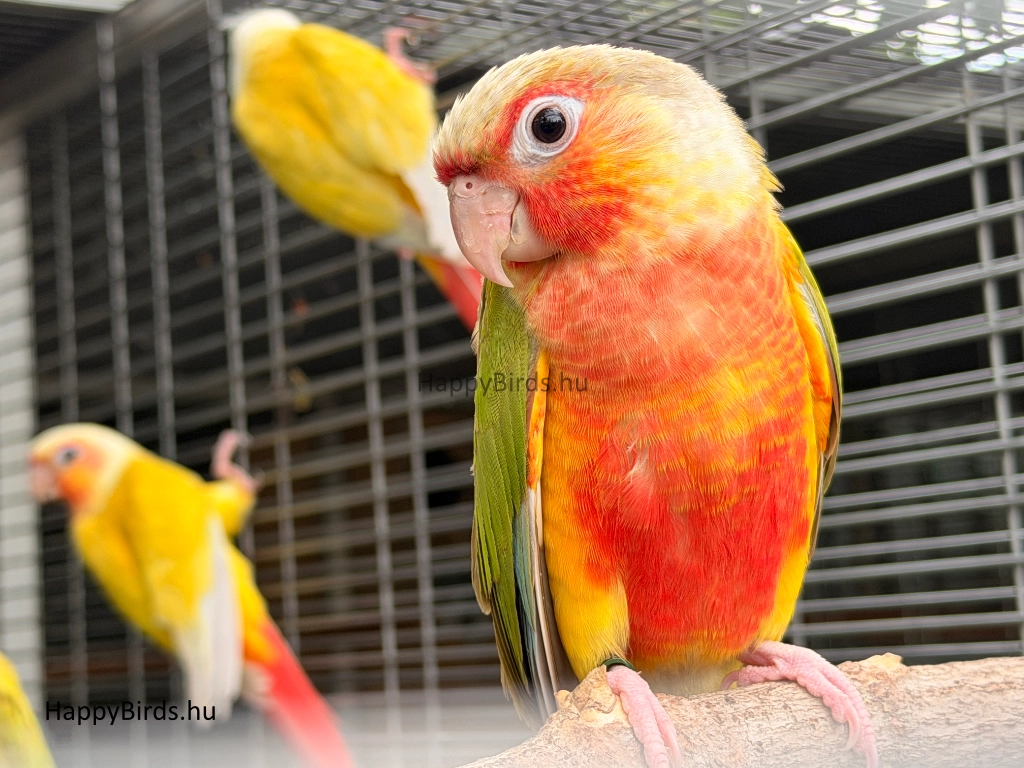
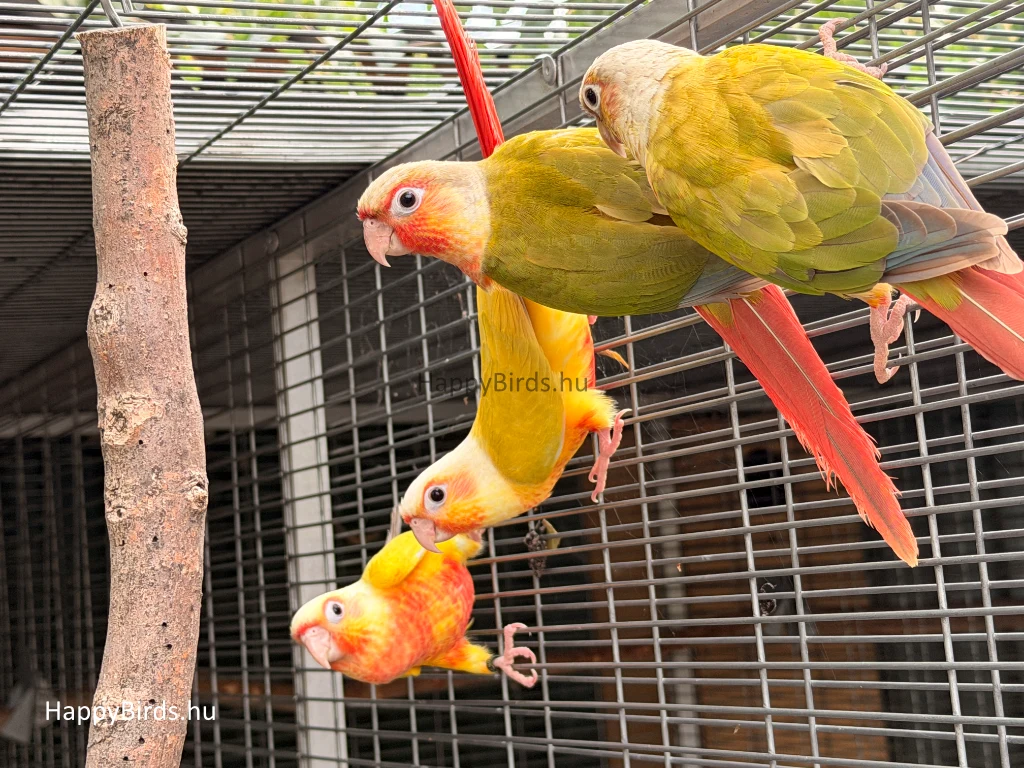
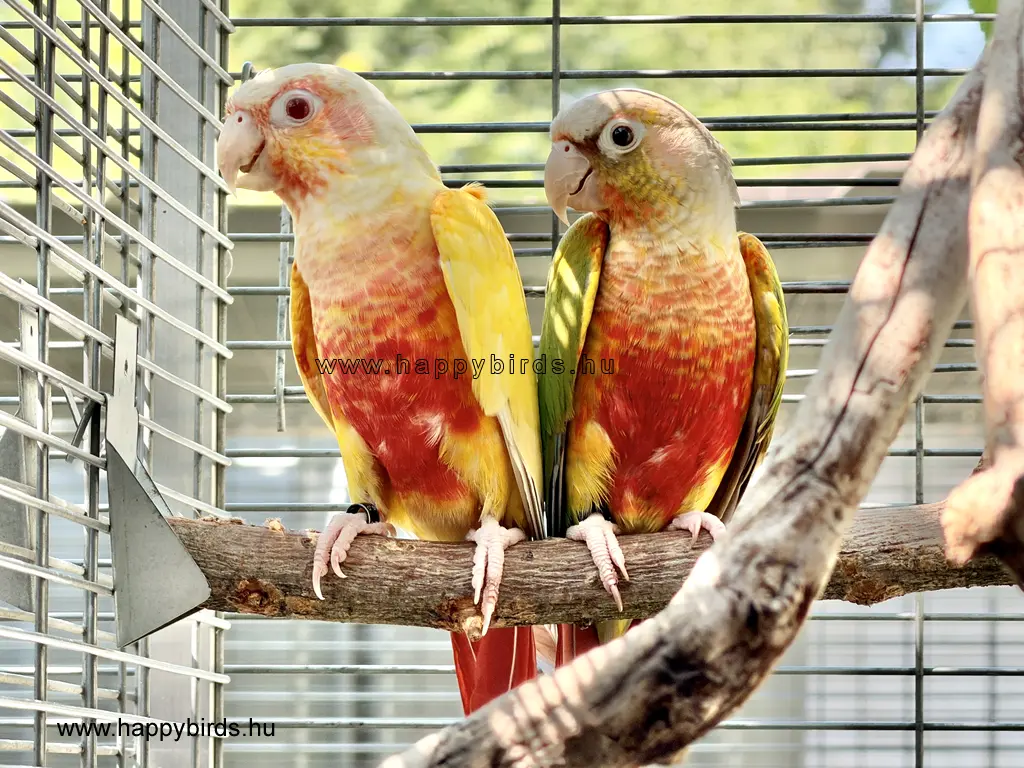
In our aviary you can find several rarer color mutations and their combinations as well. Among others: violet (viola), dilute, cinnamon, turquoise, red face, and combinations of these (pineapple, turquoise pineapple, suncheek, mooncheek).
Pyrrhura molinae color mutations
Pyrrhura molinae violet mutation overview
The violet mutation is still less common. This may be because relatively little is known about it. Violet combines well with almost all mutations. It is a co-dominant mutation, meaning that pairing a violet with a normal bird will also produce violet offspring, and pairing two SF (single factor) violets can also yield DF (double factor) violet offspring. Because it is dominant, there is no such thing as a “violet split”! In every case, the color must be visible on the bird. The easiest way to determine whether an individual is violet—and how many factors it has—is by examining the coloration of the flight feathers. For illustration, we prepared the photos below, where the difference can be clearly seen between turquoise cinnamon, turquoise opaline cinnamon, turquoise opaline cinnamon SF violet, and DF violet.


In the turquoise opaline SF violet and turquoise opaline DF violet combinations, the strength of violet is more pronounced. Personally, this is what we like the most. On turquoise birds, violet looks even more intense. Violet may also appear in green-line mutations, but it is less spectacular there. We took the photos in similar lighting conditions and of chicks of the same age. (With adult birds, coloration may vary slightly.)


TIP: If you are unsure whether a bird is violet or not, compare it with an individual that you know for sure cannot be violet.
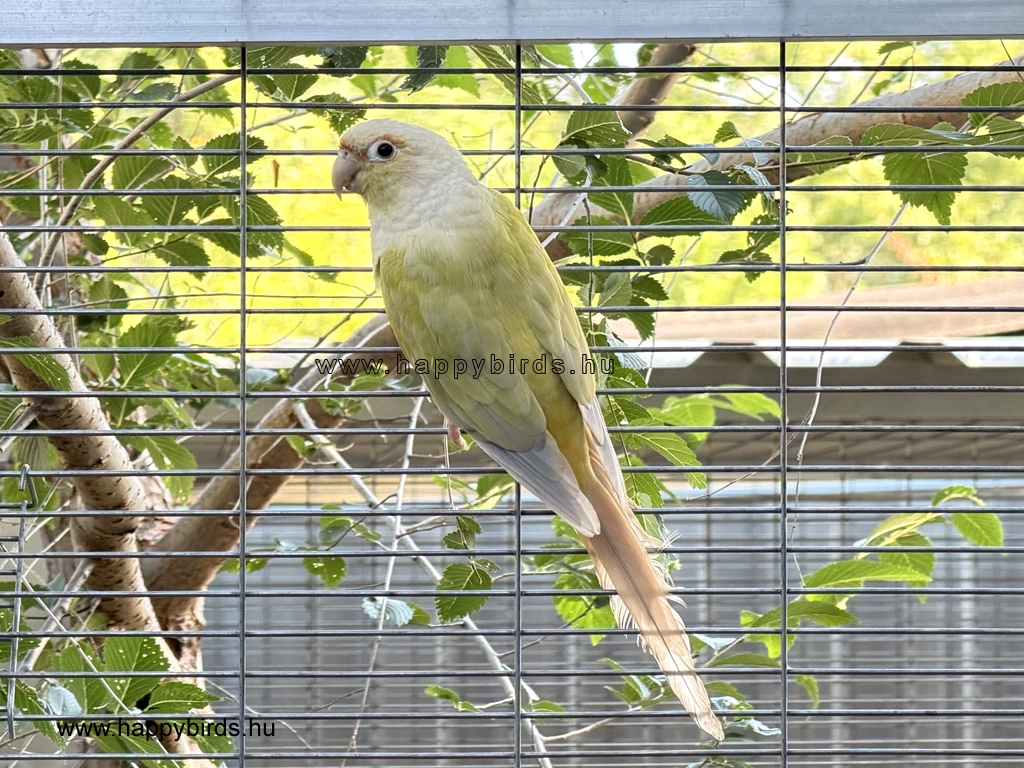
Pyrrhura molinae Photo Gallery:


Frequently Asked Questions for Beginner Pyrrhura Keepers
The thoughts below summarize some of the most common questions that come up about keeping pyrrhuras.
Can Pyrrhura molinae be kept in an apartment?

Pyrrhuras can be kept indoors, but daily exercise and an enriched environment are still essential. In an apartment you need to pay special attention to safety (wires, toxic plants, open windows) and make sure there is a “bird-proof” area for out-of-cage time. For beginners, the usual compromise is a spacious cage plus several hours of supervised free flight in a safe room every day. A key rule: a parrot should only be out under supervision.
How big should a cage be for a pyrrhura?

The bigger, the better! Pyrrhuras are active, agile birds. Pet stores often sell cages that are tall but have a small footprint. Birds need more horizontal space—a wider cage where they can move and even flutter from perch to perch. As a minimum that still fits easily in a home, I’d recommend a cage with a 100 cm × 50 cm footprint and at least 50–60 cm in height—of course with daily out-of-cage flight time. Another rule of thumb: if there’s room for one bird, there’s room for two!
A great option is to house parrots in a spacious outdoor aviary on a balcony or in the garden during the summer season.
What should a pyrrhura eat? (seed mix, pellets, fruit & vegetables)
What we love about pyrrhuras is that you can truly spoil them with all kinds of tasty treats—they’re usually not picky. Their diet should always match the way they’re kept.
Kept as a pet companion? In that case you don’t need to “condition” the diet for breeding.
Kept in a cage or an aviary? Even with daily flight time, caged pyrrhuras can gain weight more easily than their aviary-kept companions.
A good diet has several pillars: a high-quality staple diet (pellets or a species-specific seed mix), fresh vegetables daily, and fruit in moderation. You can also supplement with various grasses and safe wild greens. Fresh water should always be available, and it’s worth using metal food and water bowls because they’re more hygienic.
You can read more about proper nutrition on our housing & feeding page.
Can pyrrhuras be kept alone?
It’s best to keep all parrots in pairs. A common mistake is buying one bird with the plan: “we’ll get to know the species first, then we’ll get a mate.” Meanwhile the parrot doesn’t get enough attention, starts calling, and looks for a “partner.” Then people hesitate to get a second bird because they fear two birds will be much louder. In our experience, it’s often the opposite: two birds can be quieter than a single one, because they keep each other company and stay mentally occupied. It’s also important to note that a human can never truly replace a bird companion—behavior issues can still develop in singly kept birds even with daily interaction, ranging from screaming and biting to feather plucking. We encourage everyone not to keep social animals without a companion.
“Pair keeping” doesn’t necessarily mean one male and one female. If breeding isn’t the goal, your bird still needs company. Same-sex pairs can work too—pyrrhuras are not typically aggressive and usually don’t hurt each other. They can also be kept with other species, for example Pyrrhura molinae with Pyrrhura rupicola, or with other Pyrrhura species.
Thinking about buying a Pyrrhura? Or looking for a companion for your current bird? Check our currently available birds.
Why is a color mutation more expensive?
Since the first color mutations appeared, bird lovers and breeders have been especially interested in breeding these unusual color varieties. Today, you can find different color mutations in almost every well-known parrot species. Truly rare color varieties often sell for far more than “normal” colored birds. That’s because these birds are not only eye-catching, but also rare and genetically special—and they can be used to create new, even more interesting color combinations.
Another key factor is how a given mutation is inherited. It can be dominant (easy to pass on), recessive (both parents must carry it), or sex-linked. Some parrots also carry multiple mutation combinations at the same time. These individuals are especially valuable, as they are the result of years of selective, carefully planned breeding work.
That’s why you may see a multiple-fold price difference between a normal and a special color variety within the same species.
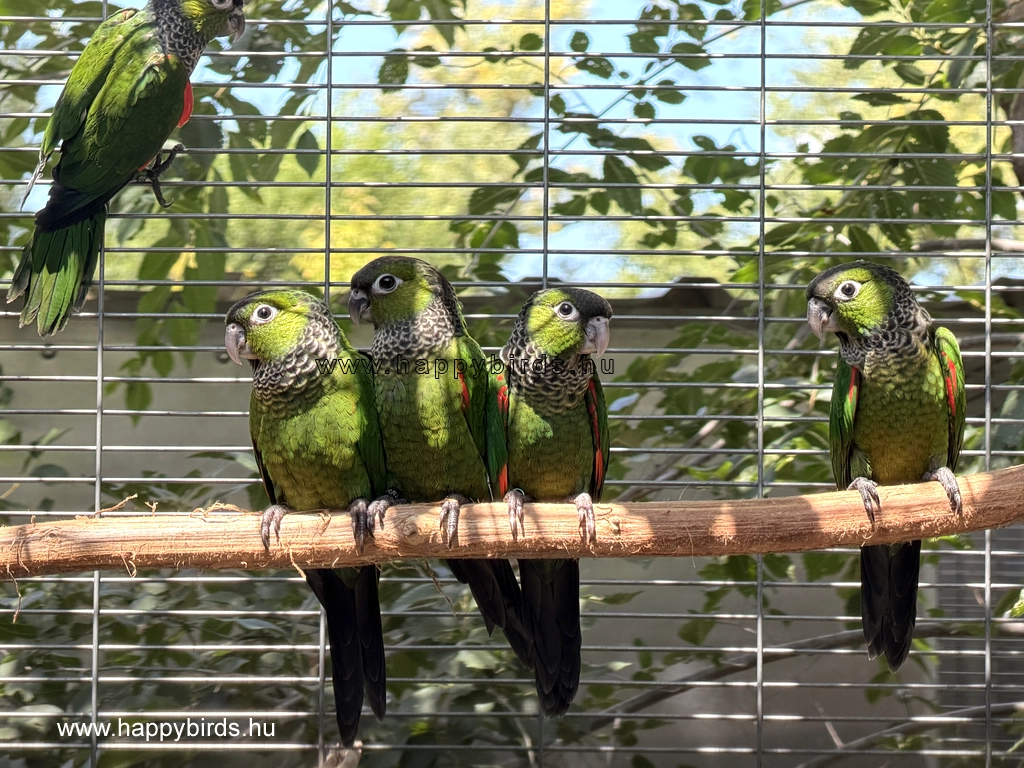
Black-capped Conure (Pyrrhura rupicola)

The Black-capped Conure (Pyrrhura rupicola) is known in English by the dark “cap” on its head, while its Hungarian name refers to the ring-like pattern around its neck. This species is native to the Amazon Basin, inhabiting the eastern slopes of the Andes in Peru, as well as parts of Bolivia and Brazil’s tropical rainforests. It measures about 25 cm in length and has a green body, with a distinct black-and-white collar pattern on the neck and chest, and red primary wing coverts. There are two recognized subspecies: Pyrrhura rupicola rupicola and Pyrrhura rupicola sandiae.
The Black-capped Conure is a highly social parrot, usually living in small flocks of 25–30 individuals. During the breeding season, they may form family groups, showing strong pair bonds and cooperative behavior. They reach sexual maturity between 1 and 3 years of age and are considered one of the quietest Pyrrhura species.
By nature, they are curious, friendly, and attention-seeking birds. When kept as pets, it’s important to provide plenty of toys and chewable branches to satisfy their natural curiosity and prevent boredom.
Pyrrhura rupicola breeding
Its breeding habits are similar to those of the Green-cheeked Conure (Pyrrhura molinae). They reach sexual maturity at around 18 months of age. The female typically lays 4–6 eggs, which hatch after approximately 23 days of incubation, and the chicks fledge at around 8–9 weeks of age. Based on our experience, this species tends to be more sensitive and easily stressed, so it is best to provide a calm and stable environment during the breeding period. The recommended closed ring size is 5 mm.
Pyrrhura rupicola Photo Gallery: